
AEO & GEO vs SEO: What's the Difference?
Understand the difference between AEO, GEO and SEO, and why it matters to your brand.
October 14, 2026
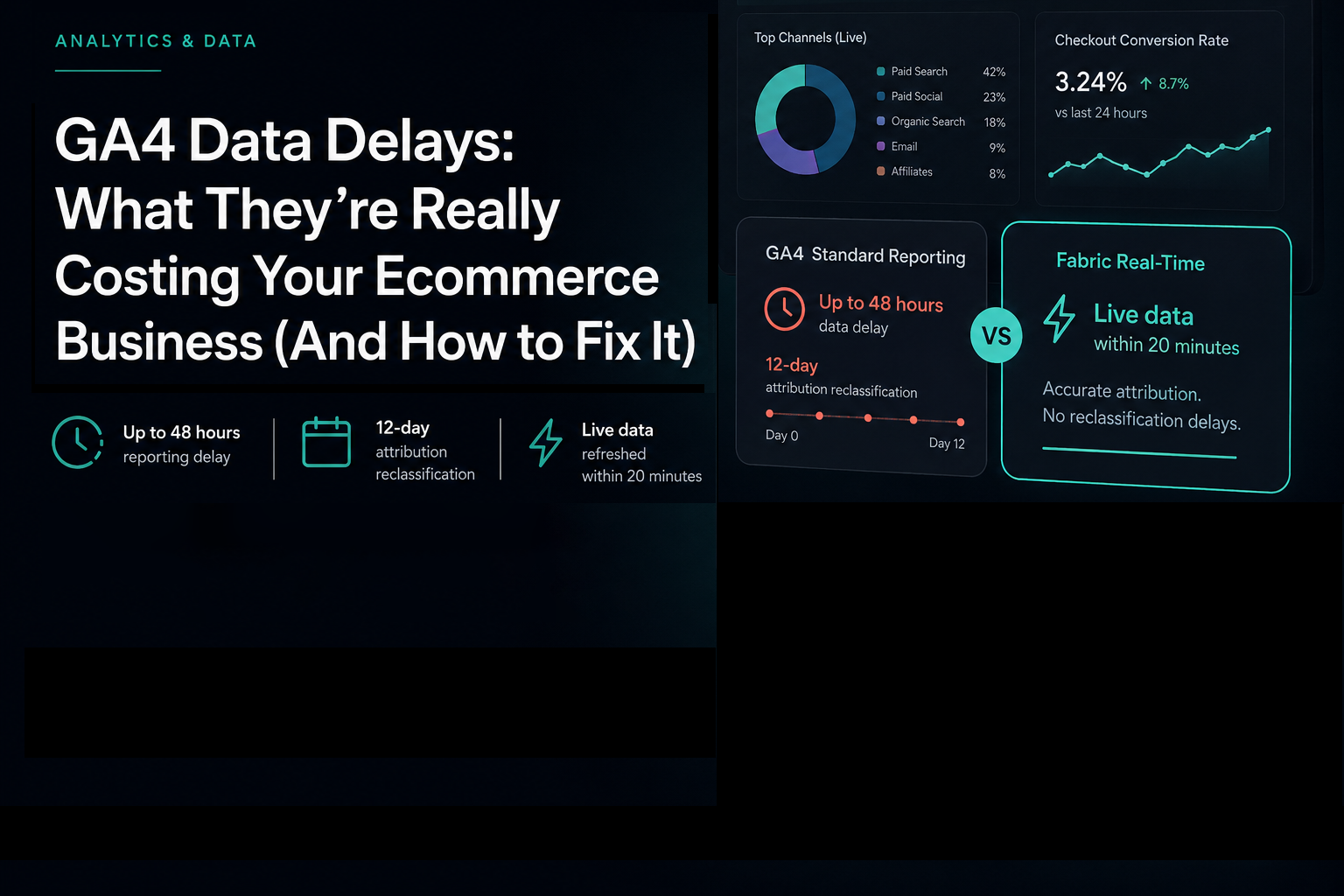

If you run an ecommerce business and use Google Analytics 4 as your primary source of performance data, there's a good chance you're making important decisions — budget calls, campaign pivots, trading responses — based on information that is hours, or even days, out of date.
This isn't a configuration problem or something you've set up incorrectly. It's built into how GA4 works. And for ecommerce teams operating in real time, it creates a significant commercial blind spot.
In this post we'll break down exactly what the GA4 data delays are, what they cost in practice, and how leading UK ecommerce brands are solving the problem.
GA4's standard reports — Acquisition, Monetisation, Engagement — carry a data processing latency of up to 48 hours. Google acknowledges this in their own documentation, noting that teams should analyse data from at least two days ago to see a complete, reliable dataset.
In practical terms, this means:
For brands in low-velocity categories where day-to-day fluctuations are modest, this might be manageable. For ecommerce teams running active campaigns, responding to live trading conditions, or launching high-demand products, it's a serious problem.
This one catches even experienced analytics teams off guard.
Google officially confirms that attribution credit for key events in GA4 — the channel data that tells you whether a sale came from paid search, organic, email, paid social, or affiliates — can change for up to 12 days after those events are recorded.
That means the channel breakdown you're looking at today is provisional. The split between paid and organic, between social and email, between your affiliate programme and your Google Ads — all of it can shift significantly over the next week and a half.
For any brand running simultaneous campaigns across multiple channels, this creates a deeply unreliable foundation for decision-making. Every budget reallocation, every bid adjustment, every channel optimisation made within that 12-day window is based on data that will later be revised — often materially.
The delays above aren't abstract inconveniences. Here's what they translate to in practice.
High-demand product drops are among the highest-stakes moments in ecommerce. A new release can generate significant revenue within minutes — but it can also sell out, encounter checkout issues, or underperform against expectations just as quickly.
With GA4's standard reporting, campaign performance during a live launch simply cannot be assessed accurately until days after the peak has passed. By the time you have reliable data, the launch window is closed. The opportunity to optimise in flight — to push harder on what's working, pull back on what isn't — is gone.
Without real-time visibility into your checkout funnel, a technical fault — a broken payment step, a failed third-party integration, an unexpected 404 — can quietly drain revenue for hours before anyone notices.
GA4's delayed reporting means these issues don't surface in your data until long after they've occurred. If a checkout step breaks at 9am and you're reviewing GA4 data at 5pm, you've lost a full trading day.
When GA4's attribution data is still being reclassified, the relative performance of your channels looks different today than it will in a fortnight. A brand that decides to scale paid social spend based on its apparent share of revenue this week might be making that call on figures that will later show a very different picture.
At scale, these misallocations compound. Teams that move quickly on channel performance — as they should — are systematically disadvantaged by a platform that cannot tell them, accurately, where their revenue is coming from until nearly two weeks after the fact.
The solution is to bypass GA4's standard reporting interface entirely and draw data from a faster, more reliable source: GA4's BigQuery streaming export.
GA4 can push event-level data directly into Google BigQuery within minutes of collection — long before it appears in GA4's standard reports and without the attribution reclassification lag. Building live dashboards on top of that BigQuery export gives ecommerce teams data they can actually act on: accurate, channel-attributed, refreshed within 20 minutes.
This is the approach behind Fabric Real-Time — and the results from brands already using it illustrate exactly what becomes possible.
Nadine Merabi is a UK luxury fashion brand with rapid international growth across ecommerce, retail and wholesale channels. As the business scaled, the team were operating with fragmented reporting, unreliable traffic source data, and no visibility into live performance during high-pressure trading periods.
GA4's delays meant that during key launches and campaigns — the moments when data matters most — the team had no reliable view of what was happening on site.
Fabric Analytics implemented Fabric Real-Time, connecting directly to Nadine Merabi's BigQuery export and delivering live dashboards covering sales, traffic, campaign performance, and checkout behaviour — all refreshed within 20 minutes.
The commercial impact was immediate. The team gained clear visibility into which influencers were driving meaningful traffic, were able to reallocate campaign spend at pace to maximise performance, and — in one significant instance — identified and resolved a stock issue in real time, protecting an estimated £60,000 in revenue that would otherwise have been lost.
Where the team had previously been making trading decisions in the dark, they were now monitoring launches as they happened and responding to the data in front of them.
Read the full case study here: https://fabric-analytics.com/case-study/nadine-merabi
A top-10 UK fashion and sports retailer — one of the country's largest ecommerce operations by traffic — faced the same structural challenge at considerably greater scale. With millions of transactions processed annually and product launches capable of generating millions in revenue within minutes, the speed and accuracy of performance data wasn't a reporting preference. It was a commercial necessity.
Their trading and ecommerce teams were relying on GA4 as their primary source of in-day insight. The 12-day attribution window meant that campaign optimisation across paid search, paid social, affiliates, email and app channels was effectively impossible to do with confidence. Checkout issues had no reliable early-warning signal. And there was no unified view of web and app performance across international markets in a single live dashboard.
After implementing Fabric Real-Time — connected directly to their BigQuery export and deployed within two weeks — the transformation was significant:
For ecommerce teams used to working with GA4, Fabric Real-Time changes the nature of trading decisions in a few specific ways:
During a product launch, instead of waiting until the following day to understand how a drop performed, the team can see revenue, conversion rate, and channel attribution within 20 minutes of going live — and optimise budgets and messaging while the launch window is still open.
During active campaigns, instead of allocating spend based on 12-day-old provisional attribution data, the team can see which channels are actually driving revenue right now and move budget accordingly with confidence.
Every day, instead of opening GA4 and seeing yesterday's picture, the team starts the morning with an accurate view of what's happening on site — and can respond to checkout issues, traffic anomalies, and performance dips before they become significant problems.
No. Fabric Real-Time is designed for any ecommerce business advertising across multiple channels — paid search, paid social, email, affiliates — where delayed data creates real commercial risk.
The two case studies above represent different ends of the scale spectrum: a luxury independent brand and a top-10 UK retailer. The benefit in both cases came from the same place: replacing delayed, provisional data with live, accurate insight that teams could actually act on.
If your business runs campaigns, monitors launches, or has a trading team that makes decisions based on performance data — real-time analytics will change how you operate.
Fabric Real-Time is built on top of GA4's BigQuery streaming export — a native Google feature that pushes event-level data into BigQuery within minutes of collection. The process from sign-off to live dashboards takes one week:
There is nothing to migrate, no new tracking to implement, and no disruption to your existing GA4 setup. Fabric manages the full process — including ongoing maintenance — so no internal engineering resource is required.
If your team is making decisions on the back of GA4 data that is hours or days out of date, a 30-minute discovery call is the fastest way to understand what's possible for your specific setup.
We'll look at your current GA4 configuration, show you exactly what Fabric Real-Time would deliver, and give you a clear picture of what live trading intelligence would look like for your business.
No commitment required. No lengthy sales process. Just a straightforward conversation about whether real-time analytics is the right fit for your team.
Fabric Analytics is a Manchester-based analytics and data consultancy specialising in GA4 implementation, data visualisation, and real-time ecommerce intelligence. To find out more visit fabric-analytics.com.
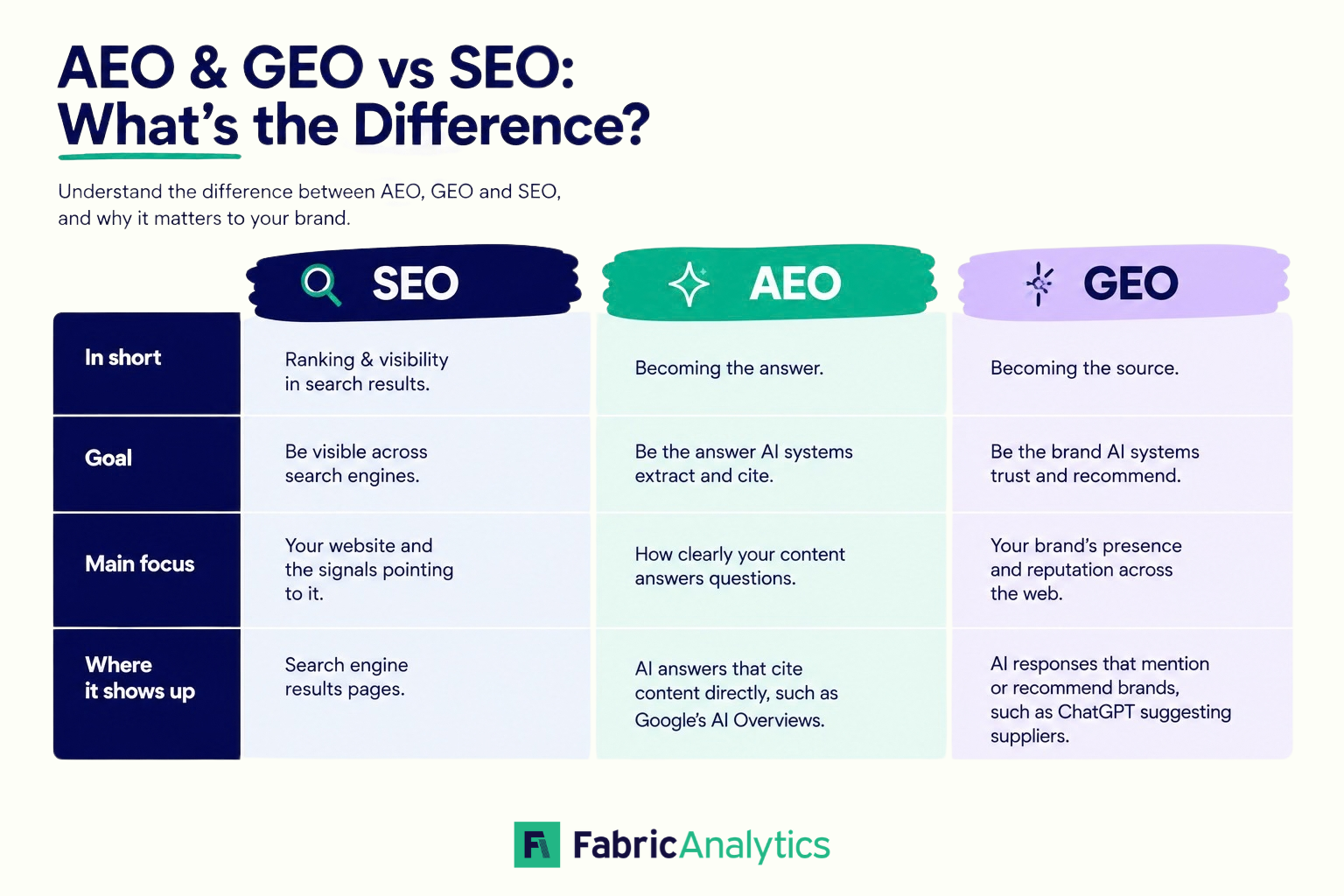
Understand the difference between AEO, GEO and SEO, and why it matters to your brand.
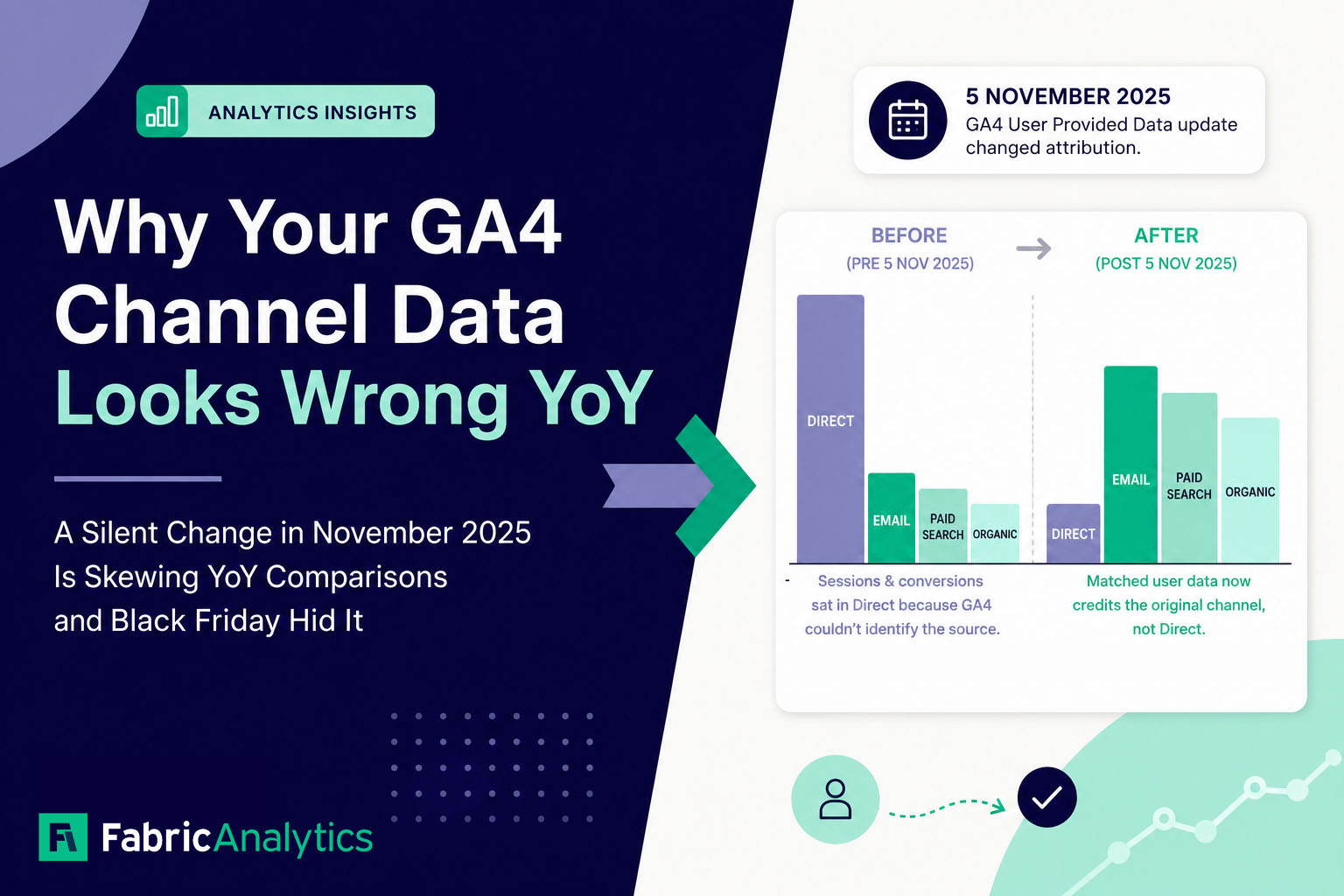
A little-publicised GA4 update in November 2025 changed how traffic is attributed, making YoY channel comparisons misleading for many businesses. Here's what changed, how to spot it, and what it means for your reporting.

Google is making a significant change to how GA4 and Google Ads share data on 15 June 2026.